
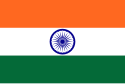

(Hindi: भारत Bhārat), officially the Republic of India (Hindi: भारत गणराज्य Bhārat Gaṇarājya), is a sovereign nation in South Asia. It is the seventh largest country by geographical area, the second most populous country, and the most populous democracy in the world.[13] Bounded by the Indian Ocean on the south, the Arabian Sea on the west, and the Bay of Bengal on the east, India has a coastline of 7,517 kilometers (4,671 mi).[14] It borders Pakistan to the west;[15] China, Nepal, and Bhutan to the north-east; and Bangladesh and Burma to the east. In the Indian Ocean, India is in the vicinity of Sri Lanka, Maldives, and Indonesia.
Home to the Indus Valley civilization and a region of historic trade routes and vast empires, the Indian subcontinent was identified with its commercial and cultural wealth for much of its long history.[16] Four major world religions, Hinduism, Buddhism, Jainism and Sikhism originated here, while Zoroastrianism, Judaism, Christianity and Islam arrived in the first millennium CE and shaped the region's diverse culture. Gradually annexed by the British East India Company from the early eighteenth century and colonized by the United Kingdom from the mid-nineteenth century, India became a modern nation-state in 1947 after a struggle for independence that was marked by widespread nonviolent resistance.
India is the world's twelfth largest economy at market exchange rates and the third largest economy in purchasing power. Economic reforms have transformed it into the second fastest growing large economy;[17] however, it still suffers from high levels of poverty,[18] illiteracy, malnutrition and environmental degradation. A pluralistic, multi-lingual, and multi-ethnic society, India is also home to a diversity of wildlife in a variety of protected habitats.

Etymology
Main article: Etymology of the names of India
The name India (pronounced /ˈɪndiə/) is derived from Indus, which is derived from the Old Persian word Hindu, from Sanskrit Sindhu, the historic local appellation for the Indus River.[19] The ancient Greeks referred to the Indians as Indoi, the people of the Indus.[20] The Constitution of India and common usage in various Indian languages also recognise Bharat (pronunciation (help·info), /bʰɑːrət̪/) as an official name of equal status.[21] Hindustan (/hin̪d̪ust̪ɑːn/ (info)), which is the Persian word for “Land of the Hindus” and historically referred to northern India, is also occasionally used as a synonym for all of India.

No comments:
Post a Comment